
By Angie & Jeff
August 25, 2026
If you make a purchase through an affiliate link on our website we might earn a small commission. There is no additional cost to you. Any and all Amazon purchases through our links can be helpful to us regardless of what you ultimately choose to purchase. Clicking through our links, and coming back to click through our links again each time before you start your shopping on Amazon, is a way you can help support our website and help us keep writing quality articles for YOU. We appreciate each and every one of you and we thank you for your support. ~ Angie & Jeff
Our time in Shipshewana, IN was hosted by Visit Shipshewana. The words in this article and the opinions we share are 100% ours.
Travel isn’t always about how far you go. Sometimes, it’s about how different the world feels when you arrive.
That’s what struck us during our time exploring Shipshewana and the surrounding communities of northern Indiana’s Amish Country. We weren’t crossing an ocean or navigating a foreign language as we often do on our travels. We were still very much in the United States.
But as we drove along country roads, watched horse-drawn buggies share the pavement with cars, wandered into businesses built around generations-old traditions, and talked with people who had created remarkably interesting livelihoods from very specific passions, it started to feel like we had traveled somewhere much farther away.
And that’s what makes an Amish Country Indiana experience so memorable.
It isn’t simply about seeing Amish buggies or buying handmade goods. It’s about slowing down enough to notice that people here have built their businesses, families, and communities around a different set of priorities.
For us, that became the most memorable part of this trip.
The First Time You Notice the Buggies
You know you’re somewhere different when you start seeing more buggies than you expected.
At first, spotting a horse and buggy along the road is novel. You slow down and point it out to your travel partner.
Then you see another.
And another.
Eventually, they become part of the rhythm of the road.
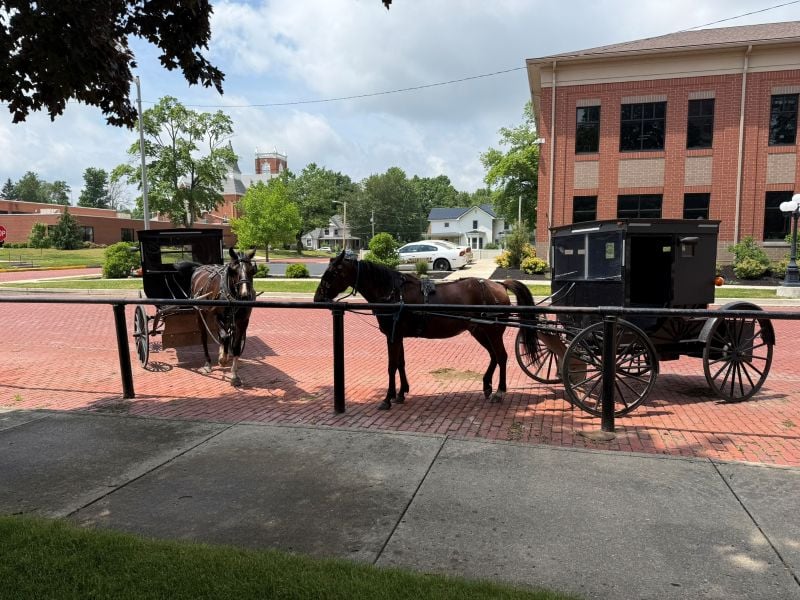
The countryside around Shipshewana is beautiful in a way that doesn’t need much embellishment. The roads wind through farmland, past homes and barns, with horses and other farm animals regularly appearing in the landscape. You quickly become aware that the infrastructure here has to accommodate both modern vehicles and horse-drawn transportation.
It’s a small but meaningful reminder that this isn’t simply a community that has preserved an old-fashioned aesthetic for visitors. This is where people live.
The buggies are transportation. The farms are working farms. The businesses are working businesses. The traditions aren’t a performance created for tourism.
That distinction changes the way you experience the area.
Businesses Operating on Different Values
One of our favorite parts of this visit wasn’t any single attraction. It was the people.
Again and again, we met business owners who had taken something they knew, something they loved, or something their families had been doing for generations and built a livelihood around it.
We were so inspired by this aspect of our visit that we devoted a full article to those stories!
The Many Honor-System Shops
One of the experiences that repeated over and over again on our visit and perfectly captured the character of the area was the many honor-system shops.
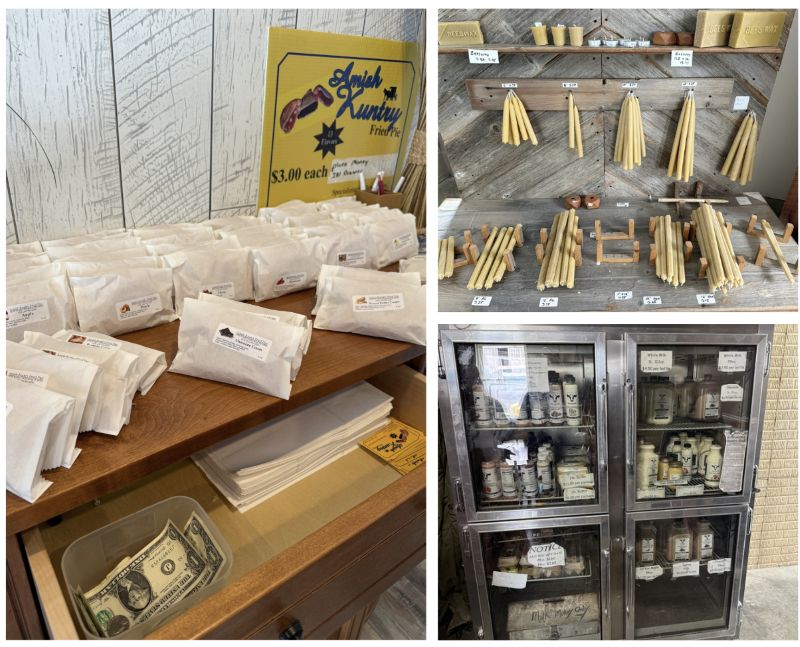
For each, you walk in, look at the products ranging from honey and bee products to amazing fried pies to fresh dairy or produce, select what you’d like, and pay on your honor in the provided containers.
That’s it.
There’s something wonderfully simple about that.
We live in a world where we’re accustomed to cameras, scanners, electronic payments, and increasingly automated everything. An honor-system store asks you to participate differently.
It assumes you’ll do the right thing.
(P.S. This leads to a tip to keep in mind for your visit. Don’t forget to have cash on hand because you don’t want to miss these stops!)
Even the products tell a story. Perry works with honey and bee-related products, while his wife sews the potholders sold in the shop. Marlon and his team make their Kuntry Fried Pies that we both still crave from our visit. The examples go on and on!
It’s a small business, but it represents something much larger about the experience here.
You aren’t simply buying a souvenir. You’re buying something connected to a person and a different culture.. And those little connections were everywhere.
Sunday in Amish Country
There’s another rhythm to Amish Country that visitors notice quickly: Sunday is different.
Many Amish businesses close on Sundays, and that means a trip here doesn’t necessarily revolve around maximizing the number of stops you can squeeze into a weekend.
Instead, Sunday can feel like an invitation to slow down.
It’s also an important reminder that the Amish communities here aren’t organized around tourism.
Visitors may arrive by the thousands, but the community’s traditions and priorities existed long before tourism became an important part of the local economy.
That can make planning a little different. Some attractions and businesses have seasonal schedules, and the famous Shipshewana Flea Market, for example, isn’t operating every day of the week or throughout the year.
But that’s part of the experience.
You adapt to the rhythm of the place rather than expecting the place to adapt entirely to you.
And honestly, that’s a pretty good lesson for travelers.
We had a delightfully fun Sunday during our visit and wrote a guide about our day for inspiration for your Sunday visit.
Family Businesses and Craftsmanship
At Yoder’s Meats and Cheese, the story begins with a great-grandfather working in the fields and continues through multiple generations.
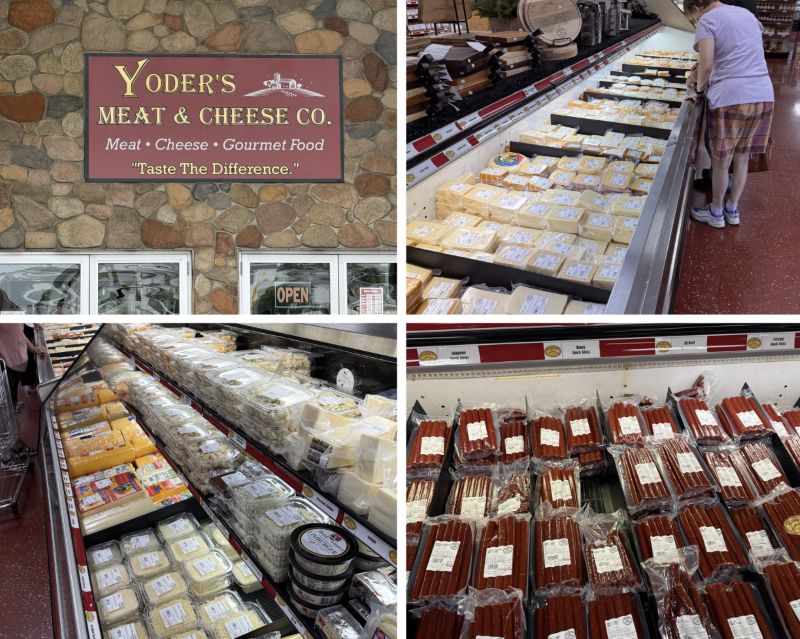
Today, the business specializes in all-natural meats and works to source ingredients as locally as possible. They raise their own cattle, source chicken locally, and work with Cook’s Bison Ranch for buffalo meat.
The philosophy is straightforward: get back to quality, clean food and do things as well as possible.
It may cost a little more.
But customers drive for hours to fill their coolers with the products.
That’s another thing we noticed here. People aren’t necessarily looking for the cheapest possible version of something.
They’re looking for something they believe is worth the drive. Our focus on budget friendly travel is often confused with cheap travel. That’s not our focus. We make careful decisions with our spending and look for places and experiences that are worth the splurge and save costs elsewhere. Yoder’s is the kind of place worth splurging.
We found a similar story at Silver Star Leather, where owner Loren originally focused on harnesses and that evolved into commercial leather work. Now, his shop is full of colorful and creative leather pieces made to last ranging from belts custom sized to you upon purchase to key chains and purses that could fit in on any city street.
It’s easy to overlook the significance of that kind of craftsmanship when we’re accustomed to products being designed, manufactured, shipped, and sold thousands of miles away.
Here, you can meet the person behind the product.
What Visitors Can Learn
The most memorable part of an Amish Country Indiana experience may not be something you photograph. It’s what you notice.
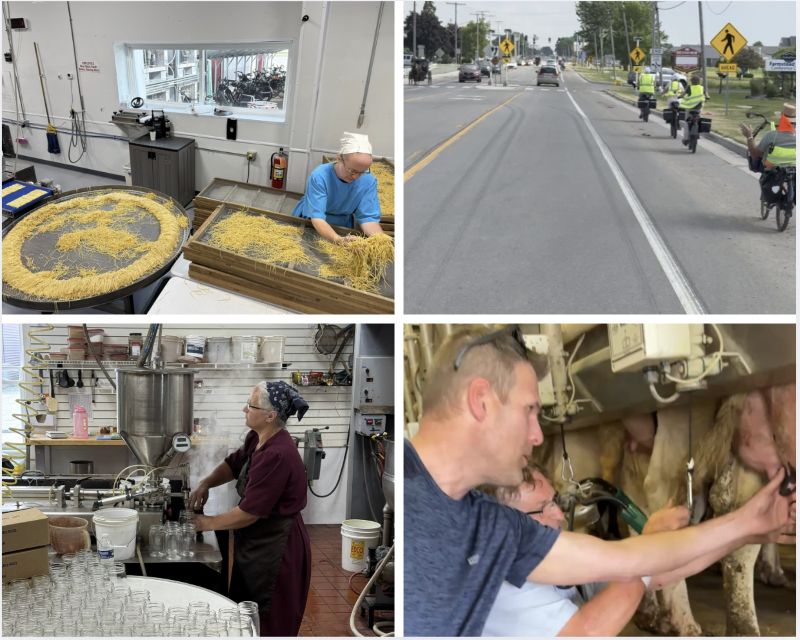
You notice that people have built businesses around their skills. You notice family businesses that have lasted for generations.
You notice food being made in quantities that rival much larger commercial operations, while still maintaining connections to local traditions.
You notice a willingness to trust customers at an honor-system store.
You notice businesses that close for religious observances rather than simply staying open because there might be money to be made.
And you notice that not everything needs to happen faster.
Travel can sometimes become a checklist. See this. Eat here. Take that picture. Move on to the next attraction.
Our time in Shipshewana reminded us that some of the best travel experiences happen when you pay attention to the people and the choices behind the places you’re visiting.
Our time with Shipshewana Buggy Rides was a perfect example of this, as our driver, Glenn, shared so much about Amish culture, traditions, and everyday life that we came away with a much deeper understanding of the community we were visiting. If you’re planning a Shipshewana visit, we think this is an experience well worth adding to your itinerary.
Why Cultural Travel Doesn’t Always Require a Plane Ticket
We love international travel.
There’s something incredible about arriving somewhere where the food, language, architecture, transportation, and everyday routines are unfamiliar.
But you don’t always have to fly somewhere to experience that feeling of being outside your normal routine.
Shipshewana gave us that feeling.
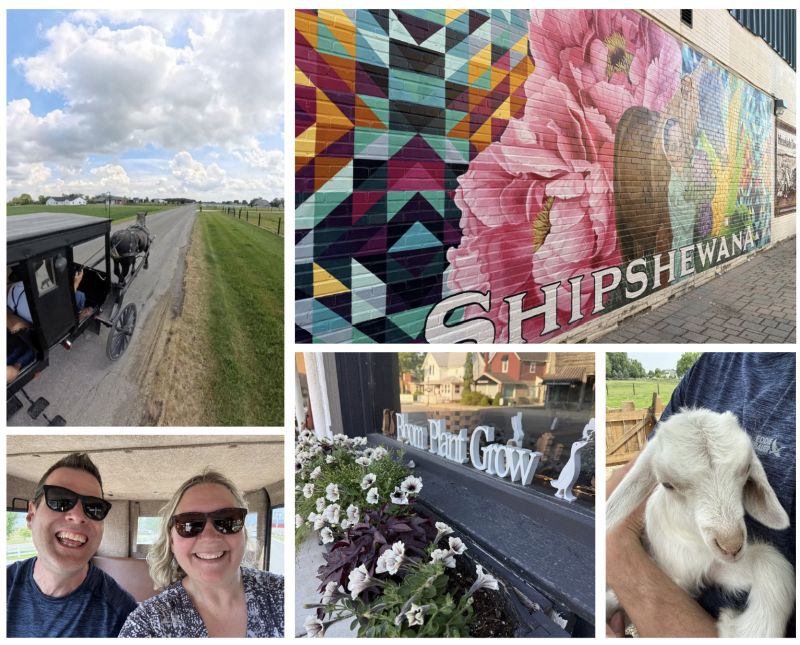
We drove through farmland and small communities. We watched buggies travel roads that have to accommodate horses as well as cars. We ate food made by businesses with deep local roots.
We heard a language that wasn’t our first language. Pennsylvania Dutch is a German dialect, so I (Angie) understood some of it with my past German studies.
We talked with people who had turned winemaking, beekeeping, leatherworking, farming, baking, meat processing, and other very specific interests into livelihoods.
We discovered that even within our own country, people can live according to rhythms and traditions very different from our own.
And perhaps that’s the real value of cultural travel.
Not just about what a place looks like, but about why it looks that way.
Why do people live the way they do?
How did that business begin?
What traditions have survived?
What values shape everyday decisions?
What can we learn by spending a little time somewhere that operates differently than home?
That’s what made our Amish Country Indiana experience unforgettable.
It was the collection of people, stories, traditions, food, farms, businesses, and everyday moments that gave us a glimpse into a way of life that exists just a few hours from home.
And that’s a pretty powerful reminder for budget-conscious travelers.
Sometimes the most meaningful travel experiences aren’t the ones that require the biggest travel budget.
Sometimes, you just need to go somewhere different enough to see familiar things in a completely new way.
No plane ticket required!
If you’re ready to plan your visit to Shipshewana, start with our Ultimate Things To Do in Shipshewana Guide here.
Ready to Travel More?
Ready to travel more and spend smarter? That’s what we’re all about. Subscribe to our free monthly email and be the first to discover new destinations, honest recommendations, money-saving travel tips, and the experiences we think are truly worth the detour. No spam—just one email each month packed with inspiration.
Get FREE Travel Tips monthly. Join our Substack.